I found my old stock picks. How badly did I do?

While tidying up this blog, I found an old page called Stocks-up. I had almost forgotten it existed.

It was a simple diary of shares I had bought or followed, with dates going back as far as 2008. At some point in 2016 I added a line saying that, had I put £500 into each of the 19 companies and still held them all, I would have been about £3,800 in profit.

That was obviously going to need checking.

I wanted to know what would have happened if I really had put £500 into every company on the date I recorded and then mostly left the whole strange collection alone. More importantly, once I started looking at it properly, I wanted to compare that with the much less exciting alternative: putting the same money into savings and leaving that alone instead.

It turns out the answer depends quite a lot on what we mean by doing nothing.

Rebuilding a portfolio I never actually had

The £500 figure on the old page was always hypothetical. My real trades varied, so this is not an attempt to recreate an old brokerage account. Instead, I have treated the page as a small experiment.

£500 into each of the 19 companies on the dates I recorded gives a total of £9,500, although the contributions were spread between 2008 and 2016 rather than invested all at once.

For companies that are still listed, I reconstructed the original holding from the historic share price and followed it through to late July 2026. For companies that were acquired, merged or disappeared, I followed the relevant corporate action instead. Where dividends and distributions were paid, I have modelled them as being reinvested where that can be reconstructed sensibly.

That last part matters much more than I expected.

The figures are deliberately approximate. Historical prices sometimes come from the nearest available trading date, adjusted-price series are being used as a total-return proxy for several long-running holdings, foreign holdings introduce exchange rates and ADR details, and Restaurant Group had a rights issue that makes a completely passive outcome unusually messy. I have excluded tax, dealing costs and personal allowances from both investments and savings.

This is an experiment, not a brokerage statement.

What happened to the £500 stock picks?

One company, CloudTag, is impossible to put a sensible current value on. It was delisted from AIM in March 2017 and shareholders retained shares in an unquoted private company. Its final public quote would have valued the hypothetical £500 holding at about £781, but that is not the same as having £781 that could be sold today.

I have therefore excluded CloudTag from the main comparison and used the remaining 18 holdings. That leaves £9,000 invested on exactly the same original dates.

Company Approx. value with distributions / corporate actions Profit / loss Approx. return
AFC Energy, now H-Power £261 -£239 -47.8%
Barclays £2,717 +£2,217 +443.4%
Boohoo, now Debenhams Group £246 -£254 -50.8%
Burford Capital £1,674 +£1,174 +234.8%
Glencore £4,349 +£3,849 +769.8%
iRobot £0 -£500 -100.0%
ITV £1,136 +£636 +127.2%
Just Eat £232 -£268 -53.6%
Kodal Minerals £1,167 +£667 +133.4%
McBride £570 +£70 +14.0%
Pantheon Resources £57 -£443 -88.6%
Restaurant Group ~£251 -£249 -49.8%
Sepura £599 +£99 +19.8%
South32 ADR ~£1,090 +£590 +118.0%
Sirius Minerals £75 -£425 -85.0%
Tullow Oil £16 -£484 -96.8%
Taylor Wimpey £584 +£84 +16.8%
Whitbread £1,018 +£518 +103.6%
Total ~£16,042 +£7,042 +78.2%

That table is much more revealing than the share prices alone.

If I simply look at the share prices and takeover proceeds, ignoring the income paid along the way, the same 18 positions come out at only about £11,500. Once dividends, distributions and material corporate actions are accounted for, the reconstructed value rises to about £16,000.

In other words, concentrating only on whether the share price went up or down misses roughly £4,500 of the result in this particular collection.

Dividends changed the answer

Glencore is the most extreme example. The original £500 at roughly 89.5p bought around 559 shares. On share price alone, those would now be worth about £3,000, which is already a very good result.

But Glencore has returned a lot of cash to shareholders over the years. Modelling those distributions being reinvested, including the June 2026 payment but excluding the distribution the company cancelled in 2020, takes the holding to roughly £4,350.

Barclays is another good example. Its share price alone turns the reconstructed £500 into around £1,565. Using a dividend-adjusted total-return series pushes that to roughly £2,717.

ITV goes from roughly £543 on share price alone to about £1,136 with distributions reflected. Taylor Wimpey goes from around £268 to £584. Whitbread goes from roughly £734 to just over £1,000, with the added complication of the very substantial capital returns that followed the sale of Costa.

None of this means dividends are free money. The share price adjusts when cash leaves a company, and reinvesting the dividend simply puts that cash back to work. The point is more basic: if the question is “what happened to my £500?”, looking only at today’s share price does not answer it.

Some of them disappeared completely

The other thing a ten-to-eighteen-year experiment gives you is plenty of corporate archaeology.

iRobot is the cleanest disaster. It entered Chapter 11 and its restructuring became effective in January 2026. The old common stock was cancelled and extinguished. £500 became £0.

Sirius Minerals was acquired by Anglo American for 5.5p per share. The reconstructed £500 holding returned roughly £75.

Sepura went the other way. Hytera acquired it for 20p per share in 2017, which turned the approximate £500 holding into £599.

Just Eat became Just Eat Takeaway.com at a ratio of 0.09744 JET shares for each original Just Eat share. Prosus then acquired the remaining JET shares, with the final minority-shareholder process in July 2026 paying €21 per share including statutory interest. Following the whole chain leaves the original hypothetical £500 at about £232.

Restaurant Group is the awkward one. It paid dividends, then ran a 13-for-9 rights issue in 2018 before Apollo eventually bought the company for 65p per share. Taking up the rights would have meant investing more money, which breaks the £500 experiment. I have therefore modelled a holder who did not add capital but retained the economic value of the rights instead. That produces a rough final result of £250, rather than the misleading £60 or so you get by simply multiplying the original number of shares by the eventual takeover price.

There is a useful lesson in that too. “I bought it and never traded it” does not necessarily mean nothing happened.

What if I had just used a savings account?

This is where it got more interesting.

I ran the same contribution dates through two cash scenarios. The first uses the Bank of England’s quoted instant-access deposit rate series as a representative mainstream savings benchmark. The second is deliberately more demanding: it assumes I was the sort of saver who regularly moved the money to competitive best-buy easy-access accounts as rates changed.

The second comparison is probably closer to what somebody means when they say, “I could have just put it in a high-interest savings account”, but it is important to recognise that it is not completely passive. You would have had to keep an eye on rates and switch accounts when better ones appeared.

Using the same 18 £500 contribution dates gives this:

Approach Money put in Approx. value by late July 2026 Approx. gain
Representative instant-access savings £9,000 £10,089 £1,089 (+12.1%)
Diligently chasing strong easy-access rates £9,000 ~£11,848 ~£2,848 (+31.6%)
Stocks, looking only at prices / exit values £9,000 ~£11,500 ~£2,500 (+28%)
Stock picks with distributions and corporate actions reflected £9,000 ~£16,042 ~£7,042 (+78.2%)

That changes how I look at the original experiment.

If I had ignored dividends and simply compared the share prices with a good savings account, all that additional company-specific risk, several near-total losses and one actual zero would have produced a result that was no better than diligently moving the money between decent savings accounts.

The investment portfolio only really pulls away once the cash those businesses returned to shareholders is included and put back to work.

Doing nothing is not really one strategy

There are at least three different versions of “doing nothing” hiding in this comparison.

Leaving money in an ordinary instant-access savings account required almost no attention, but produced the weakest result. Regularly finding a better savings rate still involved no investment risk, but it did require some maintenance and did significantly better.

Buying the shares and refusing to trade them involved much more risk. Several individual £500 positions were almost wiped out and iRobot actually was. Yet leaving the winners alone and reinvesting the income meant a handful of companies had enough time to do most of the work.

Glencore alone ends up representing more than a quarter of the measurable portfolio. Add Barclays, Burford and ITV and four companies account for well over half of its value.

That is not evidence that I was secretly a brilliant stock picker. Quite a lot of the table strongly suggests otherwise.

It is a demonstration of how uneven long-term investment returns can be. You do not need every decision to be right if the winners are allowed to keep compounding, but concentration also means the outcome can depend enormously on a small number of companies.

There is another benchmark missing here too. A diversified low-cost index fund would have been a much more conventional way to invest passively than picking 19 individual shares and forgetting about them. That deserves its own comparison rather than being squeezed into this one, because I suspect it may be the most useful benchmark of all.

So, how badly did I do?

Not terribly, as it turns out, although the answer is much less flattering if I pretend dividends never happened.

The measurable £9,000 of hypothetical stock purchases becomes roughly £16,000 once distributions are accounted for, compared with around £11,850 for a fairly diligent high-interest cash saver using the same contribution dates.

The difference is about £4,200 in favour of the shares.

But the stocks came with a completely different experience. There were huge drawdowns, businesses that disappeared, a 100% loss, rights issues, takeovers, mergers, currency exposure and a very lopsided dependence on a few winners. The savings account did none of that.

That, to me, is the useful bit of finding this old page.

The question is not simply whether shares beat cash. Over long periods you would generally expect riskier assets to offer the possibility of higher returns. It is seeing what actually creates those returns, what happens when you leave things alone, and just how much difference reinvesting the boring bits can make.

The original Stocks-up page said I was about £3,800 in profit the last time I bothered calculating it.

I then appear to have stopped checking.

Perhaps that was not the worst instinct I had.

Method and sources

This is a retrospective personal experiment, not investment advice. Figures are approximate and are shown before personal tax, dealing charges and other individual costs. The stock figures use the original dates from my Stocks-up page and a late July 2026 valuation point.

For continuously listed dividend-paying companies, historic adjusted-price data is used as a practical total-return proxy. This assumes distributions are reinvested and is not intended to recreate the exact price or timing a broker’s dividend reinvestment service would have achieved. Glencore was modelled separately from its distribution history because its pattern of returns of capital makes the simple adjusted-price approach less satisfactory.

The savings comparison compounds gross interest using the same original contribution dates. The representative benchmark is based on the Bank of England’s household instant-access deposit series. The higher-rate scenario is an approximate reconstruction from contemporary best-buy savings rates and assumes regular switching to competitive easy-access products. Neither side includes personal tax.

Useful source material:

Apparently Britain has fallen. Musk says so, so it musk be true!

A German guy in a beer queue was worried about the country I live in. So I did the only thing I really know how to do when a story doesn’t add up… I opened a spreadsheet.

Last week I was queuing for a drink at the Kirmes in Düsseldorf when a German chap asked where I was from. “England,” I said. His reaction was immediate: “What’s it like living there now? Must be scary.”

I laughed, because I genuinely thought he was joking. He wasn’t. There was an awkward little moment where I realised he had a mental picture of Britain sitting somewhere between a failed state and Middle-earth after Sauron got planning permission. London occupied by Orcs. The Nazgûl patrolling Birmingham. Small boats landing directly outside Greggs!

He went on to explain, quite sincerely, that he and various people he knew were actively avoiding coming to Britain because of what they had seen and heard about immigration, Muslims, violence and crime. That genuinely caught me off guard…

I know those conversations happen online. I know Britain gets discussed constantly in American politics and on X, and that Elon Musk in particular has spent a surprising amount of energy telling everyone we are sliding towards civil war. But I hadn’t appreciated that ordinary people elsewhere in Europe were quietly making actual travel decisions based on it.

I live here. It has changed, and there are things happening in Britain that concern me. There are things our governments have handled spectacularly badly, and subjects where parts of the establishment have been dishonest, cowardly or simply incompetent. But scary? Civil war? A country overrun by violent Muslims? That is not the Britain I recognise when I walk out of my front door.

So I did the thing I always do when something doesn’t quite add up. I opened a spreadsheet.


First, an embarrassing correction

Before I get into any numbers, I need to correct something I got wrong myself, because it turns out to be half the point.

I watched Musk’s recent interview with Zanny Minton Beddoes, the editor-in-chief of The Economist, and a few days later I watched Piers Morgan chewing over the fallout with Mehdi Hasan and others. Afterwards, if you had asked me, I would have told you that Musk’s argument was essentially that Britain has had a huge influx of Muslims who are here to rape, murder and run organised crime.

That is stronger than what he actually said. When Beddoes asked him directly whether he was anti-Muslim, he did not say Muslims were “only here” to rape or murder. What he actually said was that he opposed people coming to a country with views “antithetical” to Western values, followed immediately by “I’m against rape and murder” and opposition to imposing laws contrary to Western norms. Earlier in the same exchange he had predicted a “reckoning”, and ultimately civil war, if a rapidly growing group with incompatible beliefs kept growing. I still think that answer was appalling, for reasons I will come to. But if I am going to criticise somebody for playing fast and loose with reality, I should probably start by not doing it myself!

And that tiny example is the thing that worries me most. I watched an interview. I then watched people discussing the interview. A few days later, my memory held a harder, more explicit version of what had been said than the words that actually came out of his mouth. I am actively interested in this stuff, actively trying to be fair, and it still happened to me.

Now imagine that same process running across millions of people who take in their politics entirely through edited clips, captions, memes and somebody else explaining what somebody else supposedly said… That might be one of the biggest parts of this whole mess.


Let’s start with the uncomfortable numbers

There is a version of this debate where anybody worried about immigration gets told they are imagining it. They are not. Britain has changed significantly, and pretending otherwise is exactly the sort of thing that has taught people to stop trusting whoever is doing the reassuring.

The UK population was roughly 56.2 million when we joined the European Economic Community in 1973. The provisional estimate for mid-2025 is 69.5 million. That is around 13 million more people, or about 24% growth. Not all of that is immigration, obviously. People are born here, people die here, British citizens leave and come back. But immigration has played a very significant role, particularly recently. At the 2021 census around 10.7 million residents were born abroad, roughly 16% of the population. By June 2024 the ONS put that figure at about 13.1 million, or nearly one in five of us.

Net migration also reached a genuinely extraordinary peak. On the latest revised ONS estimates, long-term net migration hit 944,000 in the year ending March 2023. That is huge, and anybody pretending otherwise is being silly. It has since fallen sharply, to a provisional 171,000 in the year ending December 2025, with long-term immigration at 813,000 and emigration at 642,000.

So two things are true at the same time. Britain went through a historically enormous migration surge, and Britain is not currently running at that same rate of net migration. I do sometimes wonder whether modern political debate has quietly lost the ability to hold two facts in its head at once…


The Muslim population has grown too

That part is also true, and it is worth saying plainly. In England and Wales, around 3.9 million people identified as Muslim in the 2021 census, about 6.5% of the population, up from roughly 2.7 million, or 4.9%, in 2011. The share has roughly doubled since 2001. That is meaningful demographic change, and in some towns and parts of cities it is obviously far more visible than a national average of 6.5% would suggest.

If a community changes quickly, it is completely legitimate for people to talk about integration, housing, schools, language, employment, religion, public services and whether shared expectations are keeping pace. I do not think that is racist. I think refusing to discuss it is one of the reasons people stopped trusting mainstream politics in the first place.

But this is where the arithmetic starts quietly disappearing from the political story. A Muslim is not the same thing as an immigrant. An immigrant is not the same thing as an asylum seeker. An asylum seeker is not the same thing as somebody who arrived in a small boat. And none of those things is a synonym for criminal. In 2011, 47% of Muslims living in England and Wales were born here. That figure will have shifted since, but the basic point holds. When somebody talks about “Muslims coming here” as though four million people are one recently arrived population, they have already collapsed several completely different groups into one, and that is not analysis… it is storytelling.


And then there are the boats

Here is another place where I think both sides talk straight past each other. In 2025, 41,472 people arrived in Britain by small boat. It was the second highest annual total on record, behind 45,774 in 2022. I think that is a problem, and I am not going to pretend otherwise. I do not believe a country can have a credible immigration system if thousands of people can pay organised criminal networks to enter it unlawfully and then rely on a process that takes months or years to resolve. Borders matter. Control matters. The public believing the government actually knows who is coming in matters. Saying that out loud should not be controversial!

But the boats are simultaneously enormous politically and fairly small demographically. 41,472 people sits against 813,000 long-term immigrants in 2025. Those are not perfectly interchangeable measures, so I would not divide one by the other and pretend I had found some precise scientific ratio, but as a rough sense of scale, small boats are around 5% of annual long-term immigration. They are not “most immigration”. The large majority of people who move here long term come to study or to work, not on a boat in the Channel. On the ONS breakdown of non-EU long-term immigration in 2025, study accounted for roughly 47% and work for about 23%, with asylum making up around 14%. That is quite a different picture from the one you might assemble scrolling X for half an hour.

There is another inconvenient number in here too. Since 2018, about 95% of small-boat arrivals have gone on to claim asylum, and of the cases that have had a substantive decision, a significant share have been granted asylum or some other form of protection. That does not make the route acceptable. It just means “illegal arrival” and “bogus asylum seeker” are not the same statement, however neatly they rhyme. Again, the categories matter.


Britain did fail horribly on grooming gangs

Now for the bit some people reading this will expect me to skate around. I won’t. The grooming-gang scandals were real. Children were raped and abused, authorities failed them, and in some areas men of Asian, including Pakistani, heritage were significantly over-represented among suspects and offenders. The 2025 Casey audit found that in Greater Manchester group-based child sexual exploitation investigations, somewhere around 52% to 54% of suspects were recorded as Asian, against 20.9% of the local population. In West Yorkshire, Asian suspects made up about 35% of the relevant data against roughly 16% of the local population. Those figures should not be hidden, and they should have been investigated properly years ago.

One of the most disgraceful parts of this whole story is that a fear of appearing racist seems, at times, to have helped officials avoid asking obvious questions about who was offending. That is not tolerance, it is cowardice, and the people who paid for it were vulnerable girls.

But the same Casey audit is also brutally clear about a second failure. National ethnicity recording is so poor that it says the data is “not good enough to support any statements” about the ethnicity of group-based child sexual exploitation offenders across the country as a whole. That does not cancel the local evidence. It does mean local evidence does not magically become national evidence just because it makes us angry. And it is worth remembering how many separate categories get quietly merged in these conversations, because “Asian” is not the same as “Muslim”, which is not the same as “Pakistani”, which is not the same as “foreign-born”, which is not the same as “asylum seeker”, which is not the same as “small-boat arrival”. Stack those on top of one another and you can end up describing a population that does not actually exist in any dataset.

I think this is one of the hardest things to say honestly in the current climate. There was a real, ethnicity-related pattern in some grooming-gang offending, and it is also wrong to use that fact to smear British Muslims in general. Both of those are true at once, and if that feels uncomfortable, good… it should.


Is Britain becoming more violent?

This is where the apocalyptic version really struggles. The Crime Survey for England and Wales estimates around 989,000 incidents of violence with or without injury in the year ending March 2026. That is 33% lower than a decade earlier, and 78% below the 4.5 million peak back in 1995. Homicide has fallen too. There were 522 homicide victims in the year ending March 2025, a rate of 8.6 per million people, the lowest since 1977. That is simply not what a country descending into generalised violent chaos looks like.

But I do not want to do the mirror-image thing that some commentators do and announce “crime’s down, everyone stop worrying,” because crime is not one thing. Sexual offences in particular deserve honesty rather than a reassuring graph. The Crime Survey estimates that 2.4% of people aged 16 to 59 experienced sexual assault in the year ending March 2025, up from 1.7% a decade earlier, and that increase is statistically significant. So if somebody tells me sexual violence is a real concern, I am not going to wave falling burglary figures at them. But if somebody tells me Britain is living through an explosion of rape and murder caused by Muslims, the national data simply does not establish it. That is not political correctness. It is an inconvenient denominator.


Hate crime produces another statistical trap

Police-recorded hate crime has risen dramatically over the last decade, which at first glance looks like a country getting steadily more hostile. Then you look at the Crime Survey, which estimates about 176,000 hate-crime incidents a year across the combined 2022 to 2025 period, roughly 43% lower than the estimated 307,000 a year back in 2007 to 2009.

So how does recorded hate crime go up while survey-estimated hate crime goes down? Because the police got much better at recording it. Definitions changed, victims became more willing to report, officers became more likely to flag a hate element, systems changed and new offences were created. This is exactly the sort of thing that makes crime statistics maddening and fascinating in equal measure, and it is a lovely example of how somebody can produce a technically accurate chart that leads you to a completely wrong conclusion.

Hate crime also responds sharply to events. The Home Office points to spikes around the 2016 EU referendum, the 2017 terror attacks, the Black Lives Matter protests and far-right counter-protests in 2020, the start of the Israel-Hamas conflict in 2023, and the disorder after the Southport murders in 2024. In the year ending March 2025, recorded religious hate crime aimed at Muslims rose 19%, with a pronounced spike around Southport. That does not sit comfortably in either side’s preferred story, which is usually a decent sign you are looking at something real.


I think the internet is the missing line on the graph

This is the part I had not really thought about properly until I started plotting the data. Household internet access in Britain has gone from a novelty in the late 1990s to near universal. By 2020, 96% of households had access, and Ofcom now reckons 89% of adult internet users are on at least one social-media platform. That is an almost unbelievable social transformation to have happened inside a single adult lifetime.

And unlike population change, which happens slowly, the internet changes what we experience almost instantly. A murder happens in Southport and within minutes millions of people can see images, claims, rumours, misinformation, political reactions, eyewitness accounts, conspiracy theories and furious commentary. Some of it is true, some of it false, some of it deliberately manipulative. Algorithms then quietly work out which bits keep you looking at your phone, and the event stops being an event. It becomes content. It gets clipped, captioned, reposted, translated, reacted to, and placed next to a similar incident from six months ago, then another from three years ago, until your phone appears to be showing you one endless continuous emergency that is really a collage assembled across time and geography.

Ofcom’s latest research on this is extraordinary. 77% of UK adult internet users said they had come across hateful content online in the previous year. 65% had seen hate directed at asylum seekers, 61% at people born outside the UK, and 58% at ethnic minority groups. That tells us something important, but it is not that 77% of Britain is hateful. It is that hate is now incredibly visible… and those are two very different things.


Our brains were not designed for this

For most of human history, the things you saw repeatedly were things happening near you. If you kept seeing violence, something was very likely wrong in your immediate surroundings, and that mental shortcut made complete sense. Now I can sit in a quiet house in Sussex and watch ten violent incidents from Manchester, London, Birmingham, Paris, Stockholm and New York before breakfast. My brain still registers “repeated evidence of danger”. It is much less good at remembering that the sample has been hand-picked by an engagement algorithm out of hundreds of millions of lives.

I think that explains a lot of the strange disconnect I ran into in Düsseldorf. The German guy had never been to Britain recently, but he had seen Britain, over and over, on his phone. And those two things are psychologically almost the same thing now. Beddoes actually made a version of this point to Musk in the interview, telling him that Americans kept approaching her convinced London was extraordinarily dangerous, full of grooming gangs and violence, because of what was circulating online. Musk’s response was essentially that she lived a cloistered existence and that he understood Britain better, while also admitting he had not actually visited for several years!

I find that genuinely extraordinary. Not because someone living abroad can never understand Britain, but because it captures this new confidence we have developed that the feed is somehow more real than the place.


Musk’s answer bothered me, because he is clever enough to know better

I am not a Musk fanboy and I am not a Musk hater either. He has built genuinely extraordinary things and can clearly think with enormous precision about hard engineering problems, which is exactly why his answer to the anti-Muslim question was so disappointing. “My partner is half Indian” is not a serious response to whether your rhetoric is racist, and being Indian is not itself a racial category anyway. Answering “are you anti-Muslim?” by immediately reaching for rape and murder builds an association whether you spell it out or not. Maybe that was not the intention. But if a man whose entire public brand rests on intelligence and first-principles reasoning cannot see the category error sitting in the middle of that sentence, I find that very hard to believe.

Race, religion, nationality, migration status, legal status and criminality are all different variables. If you are going to build a thesis that predicts civil war in Britain, getting those variables straight feels like a fairly basic entry requirement! And The Economist is not immune to the same trap. During the same exchange, some of the counter-claims about how much safer London is than American cities were rhetorically stronger than I would be comfortable putting in a spreadsheet without first defining what “safe” actually means and which cities I was comparing. When one sweeping claim gets answered with another sweeping claim, public trust does not magically recover just because the second conclusion happens to sit closer to the evidence. This really should not be Team Musk versus Team Economist. The numbers do not care who wins.


There are things about Britain I am worried about

I am worried about the speed of demographic change in some places. I am worried that immigration policy has too often been something done to the public rather than something politicians felt they had to keep democratic consent for. I am worried about small boats, because visibly losing control of a border damages confidence far beyond the actual number of people arriving that way. And I am worried about integration. Not because I expect everyone who comes here to eat roast beef and support Everton, although the country would obviously improve enormously if they did! But because liberal societies rely on a few shared, non-negotiable rules. Equality before the law, freedom of speech, freedom of religion and freedom from it, women’s rights, gay rights, democratic government, and the right both to criticise a religion and to practise one. Those are not ethnic characteristics, they are civic expectations, and if somebody moves here and fundamentally rejects them, I do not think it is remotely extreme to say we have a problem.

Where Musk loses me is the leap from that perfectly defensible idea to treating a growing Muslim population as evidence of an approaching civil war. Four million people are not one opinion. Neither are seventy million Britons…


Britain is also failing to talk honestly about scale

There is an instinct in parts of the political and media establishment to dismiss people’s lived experience because a national average tells a tidier story, and that is a mistake too. If your town has changed enormously in ten years, being told that Muslims are only 6.5% of England and Wales is not much use to you. If the local school fills up, housing gets tighter, the GP becomes impossible to reach and the high street looks completely different, then someone telling you “immigration is not very large by historical standards” is not going to convince you that you imagined it.

National averages can hide intense local change. But local experience can also produce terrible national assumptions. Both are sampling problems, and the responsible answer to either one is not “nothing to see here”. It is to go and measure it properly.

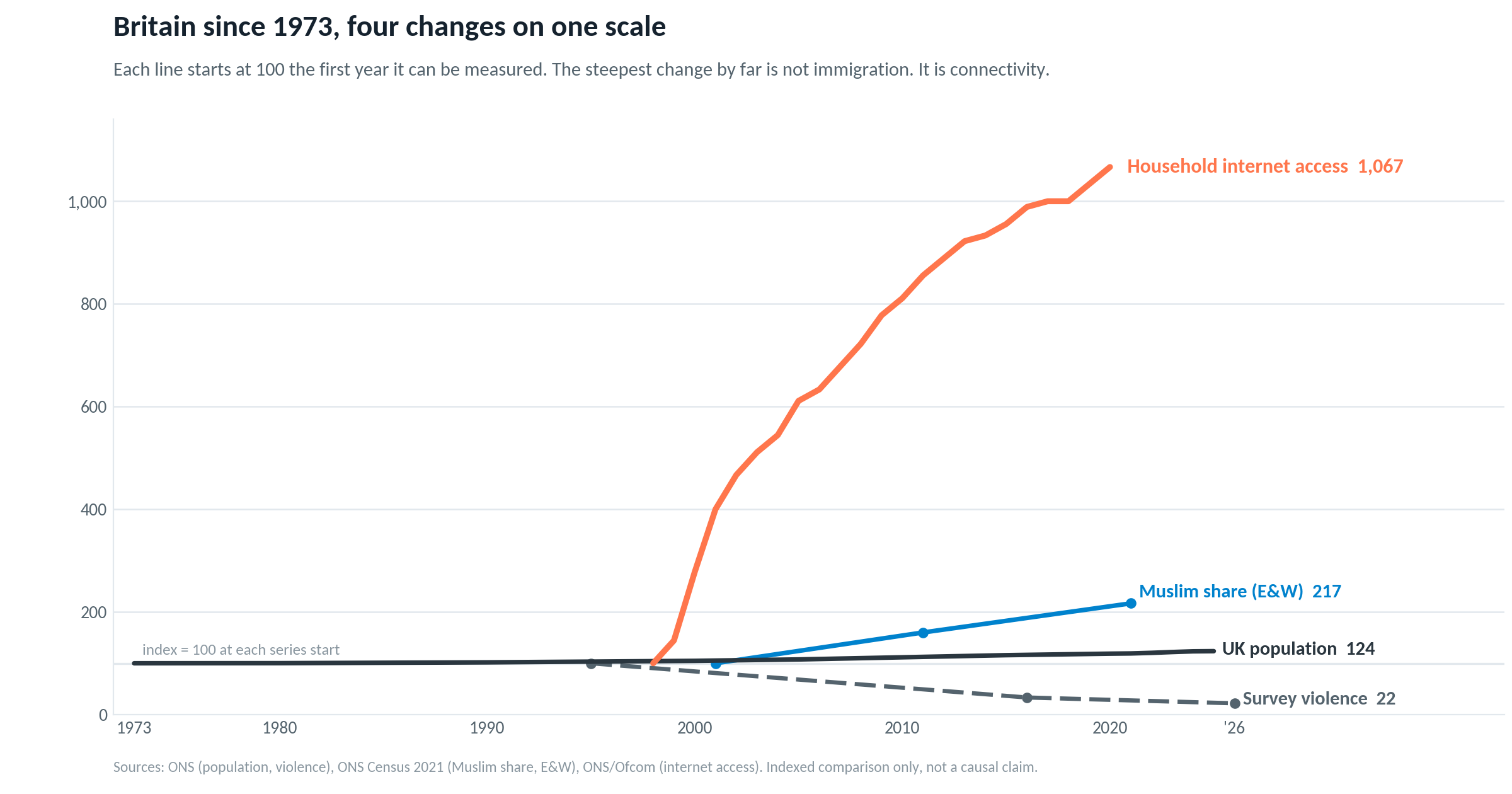
Indexed chart comparing UK population, Muslim population share, household internet access and survey-reported violence since the 1970s.

The graph that surprised me

I ended up building an indexed chart. Not because index charts prove causation, they absolutely do not, but because they are good at showing how quickly different things have changed relative to each other. I set each series to 100 at its first usable reading. UK population starts at 100 in 1973 and reaches roughly 124 today. The Muslim share of England and Wales starts at 100 in 2001 and reaches about 217 by 2021. Household internet access starts at 100 in 1998 and passes 1,000 by 2020. And long-run survey violence, indexed to its 1995 peak, falls to around 22.

Sit with that for a second. The country got bigger. It became much more diverse. The Muslim population grew considerably. The internet absolutely exploded. And general violence fell dramatically. None of that proves immigration reduces crime, or that the internet causes social conflict, or anything causal at all. But it should make us instantly suspicious of any story where one line goes up and therefore another thing must have followed it. The biggest transformation on that chart is not immigration at all. It is connectivity.


Britain may have a perception crisis as much as a crime crisis

That does not mean perception is fake, though. Perception changes behaviour. My German friend in the beer queue was seriously considering not visiting Britain, and that has a real economic effect. If communities believe crime is out of control, it corrodes trust. If Muslims repeatedly see themselves depicted as invaders or predators, it affects how welcome they feel. If non-Muslim Britons only ever see the most extreme Islamist preacher, criminal or protester available anywhere in Europe, it shapes what they assume their actual Muslim neighbours think. And if politicians start responding to those perceptions instead of the reality underneath them, perception quietly becomes policy. Occasionally it becomes something worse than that, because the Home Office data on hate-crime spikes around major political and terrorist events makes painfully clear how fast feeling turns into action. Social media did not invent any of this hatred. It has just industrialised the distribution of it.


The most dangerous combination is real failure plus exaggeration

This, I think, is where Britain genuinely does have a problem. Not Sauron. Not imminent civil war. A feedback loop. Something genuinely bad happens. The authorities mishandle it at first. Politicians reach for careful language that comes across as evasive. People conclude there is a cover-up. Online accounts publish more and more extreme interpretations, the most emotionally powerful version travels furthest, and traditional media responds by correcting the exaggerations, sometimes without giving enough weight to the real failure sitting underneath them. That correction then gets read as further proof of the cover-up, trust falls again, and round it goes.

The grooming-gang scandal is almost the perfect illustration. Authorities really did fail. Ethnicity really was relevant in some places. People raising it really were sometimes dismissed. And that history has created extremely fertile ground for someone now to say almost anything about Muslims and be met with “well, they lied to us before.” That is an incredibly dangerous legacy, and it is precisely why accuracy matters even, especially, when accuracy is uncomfortable.


So has Britain been taken over?

No. That is ridiculous. Britain has been through enormous social change. Immigration became exceptionally high and has since fallen. The foreign-born population has grown, the Muslim population has grown, some communities have integrated brilliantly and some have not. A few crime problems have got worse while many forms of violence have got dramatically better. Some serious criminal patterns involving particular communities were ignored for far too long. Small boats are a genuine failure of border control but a minority of immigration. Muslims themselves experience a great deal of hate crime. And nearly everyone is now walking around with a machine in their pocket designed to feed them an unusually concentrated selection of whatever frightens, enrages or confirms them most efficiently.

That is a rather more complicated answer than “Britain has fallen.” Unfortunately, it also makes a terrible meme…


What I think we need to get better at saying

Most of this comes down to being able to hold two true things at the same time. Immigration can be too high without immigrants being bad people. Borders can matter without foreigners being the enemy. Integration can be expected without demanding cultural uniformity. Islamist extremism can exist without Islam being a synonym for it. Grooming gangs can show real ethnic patterns without Asian men in general being predators. Muslims can suffer genuine racism and religious hatred while some conservative Islamic beliefs can still be legitimately criticised. Violent crime can fall while sexual violence remains a serious worry. Recorded crime can rise while the underlying prevalence falls. And Britain can have serious problems without being a failed country.

If your politics cannot accommodate all of those sentences at once, I would gently suggest your politics has become more important to you than actually understanding what is happening.


Back to Düsseldorf

I do not know whether I changed the German guy’s mind. We had a drink, we talked about Britain, and I told him he should come over. He would probably survive! Most of us do. He might even enjoy it.

That conversation has stuck with me because it was the first time I properly realised the online story about Britain is not staying online. It is quietly becoming Britain’s international reputation. And I do not want that corrected with propaganda about how everything here is wonderful, because it is not. I want it corrected by us being adult enough to talk honestly about what has actually gone wrong, measure it properly, and refuse to flatten millions of different people into one convenient villain.

Britain has not been conquered by Sauron and the Nazgûl. We have got immigration problems, political problems, crime problems, cultural tensions, failing institutions, a fair bit of social-media brain rot and some genuinely appalling data quality. Which is to say… Britain. Messy. Occasionally infuriating. Still here. And almost certainly a good deal safer than your phone makes it look.


First thing I have written here in a while. I have been heads-down building Jawwws, but I have missed thinking out loud in long form, so I am planning to do more of it here again.


Where the numbers come from

The beauty of sleep

Yesterday I wandered into Waterstones and picked up Arnold Schwarzenegger’s new book, Be Useful: Seven Tools for Life, on the day it came out.

I like books anyway, particularly proper physical ones that end up battered, folded over and sitting on a shelf as a reminder of what you were interested in at a particular point in your life. This one caught me because of the title as much as anything. Be Useful is such a simple instruction, and it happens to align pretty closely with something I’ve always believed about time: whatever hours you have available, try to do something useful with them.

Then I remembered an unfinished article about sleep sitting somewhere in my old notes.

I found it, checked the date and laughed. I had started writing it on 10 October 2016. Arnold’s book came out on 10 October 2023, exactly seven years later.

Apparently the best way to demonstrate a belief in using time wisely is to leave an article about it unfinished for seven years.

The old version is quite funny to read now. There are bits I still agree with, chunks of research pasted in from different places, several Steve Jobs quotes because apparently that was compulsory in 2016, and a slightly obsessive attempt to work out whether sleeping less meant somehow getting more life.

The question itself still interests me, though.

How much sleep do we really need, and what exactly are we doing with the hours when we’re awake?

Eight hours has always bothered me

Sleep is one of those things most of us think we understand because we’ve been told about it since childhood. Go to bed at a sensible time, get eight hours, don’t stay up all night and everything will be fine.

Ask somebody how much sleep they need and they’ll generally give you a surprisingly precise answer. Eight hours. Nine hours. Six and a half. Some people will tell you they simply cannot function without a particular amount, while somebody else will proudly explain that they have survived on four hours a night since 1998.

I used to say I needed eight or nine because that was what I assumed a proper night’s sleep looked like.

The arithmetic was the part that always bothered me. There are 24 hours in a day, so eight hours asleep means spending a third of it unconscious. Apply that across an entire lifetime and the number becomes slightly uncomfortable. We’re talking about decades of our lives spent asleep.

My instinct has always been to look at that and wonder whether some of those hours could be put to better use.

That probably says as much about me as it does about sleep.

I don’t particularly like wasting time. I don’t mean that in the modern productivity sense where every spare fifteen minutes should apparently become a side hustle, a podcast or an opportunity to improve your personal brand. I quite enjoy doing nothing when I have deliberately decided to do nothing.

What frustrates me is time that disappears without achieving anything or being particularly enjoyable.

A meeting that could have been an email. Filling in the same information for the third time because two systems don’t speak to each other. Watching something I’m not actually interested in because it’s easier than switching it off. Picking up my phone to answer one message and eventually realising I’ve spent half an hour looking at things I couldn’t tell you about five minutes later.

That kind of time feels expensive to me because there is no way of getting it back.

Arnold and the six-hour thing

Arnold has been making the same joke about sleep for years. There are 24 hours in a day, he sleeps for six and that leaves eighteen. If you say you need eight hours, his answer is basically that you should sleep faster.

It’s a very Arnold Schwarzenegger way of making a point.

I don’t take it as medical advice, and nor should anyone else. Current sleep guidance is fairly clear that most healthy adults should regularly be getting at least seven hours, and there are very good reasons not to turn chronic sleep deprivation into some strange badge of ambition.

But I understand what he’s getting at.

The useful part of the idea isn’t really the six hours. It’s the eighteen.

What are you doing with them?

I’ve always thought of it as being useful in the hours. That doesn’t necessarily mean working. An hour spent with your children is useful. An hour talking to a friend is useful. Reading something interesting, learning how something works, playing sport, building something entirely unnecessary because you’re curious, going somewhere new, fixing the stupid thing in the house that has annoyed you for six months, all of those count.

Even sitting quietly doing absolutely nothing can be useful if that’s genuinely what you need.

The difference, for me at least, is intention. I dislike looking back at an evening or a day and realising the time simply vanished.

Sleep makes that idea awkward because reducing it appears, on paper, to create more hours.

If you sleep six instead of eight, you’ve gained two hours a day. That’s fourteen hours a week and more than seven hundred hours over a year. Look at the number like that and it sounds enormous.

Except the maths is missing something fairly important.

The quality of the hours.

Being awake isn’t the same as being useful

This was the biggest problem with the original version I wrote in 2016. I had found some interesting research around sleep deprivation and performance, particularly the fact that somebody who is tired can sometimes perform perfectly well when concentrating hard on a specific task.

I found that fascinating because it appeared to support something I’d seen plenty of times in real life. Somebody can have hardly slept and still look completely alert in a meeting, solve a problem, write code or produce something good.

The failure tends not to happen while you’re forcing yourself to concentrate. It happens when concentration drops, as it naturally does throughout a day. A properly rested brain is better able to recover its attention. A tired one becomes inconsistent.

That makes sleep deprivation deceptive.

You can still function. You can still talk, work, answer emails and convince everybody, including yourself, that you’re fine. What becomes harder to see is the gradual loss of judgement, patience, memory and concentration.

I’ve certainly experienced that.

There are nights when working late has been brilliant. The house is quiet, messages have stopped arriving and I’ve been completely absorbed in solving something. Some of my best thinking has happened during those hours because there was finally nothing else competing for attention.

There have also been nights when I’ve stared at the same problem for two hours, becoming increasingly determined that I was going to solve it before going to bed, only to wake up and fix it almost immediately the next morning.

That is a fairly humbling demonstration of what sleep can do.

If I gain two waking hours by sleeping less but then spend three hours the following day being slower, less creative and slightly grumpier, I haven’t discovered additional time. I’ve just redistributed it badly.

Sleep is probably maintenance rather than lost time

That’s where my thinking has changed most since I first wrote this.

In 2016 I was looking at sleep mainly as time consumed. If I slept eight hours, those were eight hours unavailable for everything else.

I don’t think that is the right way to think about it anymore.

Sleep is closer to maintenance.

There’s a temptation, especially if you enjoy building things or running businesses, to regard maintenance as something that interrupts productive work. Anyone who has managed software or machinery knows where that eventually leads. You can postpone maintenance and enjoy a little more output for a while, but the underlying system doesn’t stop accumulating the consequences.

Human beings appear to be annoyingly similar.

Sleep is involved in memory, attention, physical recovery, immune function and a collection of other things I am not qualified to explain in any useful scientific detail. What matters to me is simpler: I am obviously better at most things when I’ve slept properly.

That makes the trade rather different.

If eight hours of sleep gives somebody sixteen genuinely good waking hours, that may be a far better use of a day than six hours of sleep followed by eighteen mediocre ones.

Equally, I don’t think eight should become a target people worship regardless of how they actually feel. Sleep needs vary, and duration is only part of the equation. Seven solid hours at roughly consistent times can be very different from eight hours spent repeatedly waking up or staring at the ceiling.

The better question is probably whether the sleep you’re getting leaves you properly functional for the life you’re trying to live.

Modern life isn’t exactly helping

The other thing that has changed dramatically since I started the original article is the amount of our lives now fighting for attention.

Phones were obviously already part of life in 2016, but the relationship has only become more intense. We carry work, news, entertainment, friends, arguments, games, shopping and effectively the collected knowledge of civilisation in something that sits on the bedside table.

Then we wonder why our brains don’t politely shut down the moment we turn the light off.

There is something slightly absurd about spending the evening worrying that we aren’t getting enough sleep while holding a device deliberately designed to make putting it down difficult.

Stress has a similar feedback loop. You sleep badly because something is on your mind, then deal with it less effectively the next day because you’re tired, which gives you more to think about when you go back to bed.

None of this has a particularly exciting solution. Regular sleeping hours help. Less bright screen light immediately before bed helps. A quiet, dark room helps. Exercise helps many people. If you genuinely have persistent sleep problems, proper medical advice is probably more useful than another productivity blog telling you to wake at 5am.

Annoyingly, quite a lot of sensible health advice is boring.

Be useful in the hours

So I still like Arnold’s six-hour story, even though I don’t intend to organise my sleep around it.

The line reminds me that time is finite, and that’s enough.

Be Useful isn’t really a complicated instruction. The interesting part is deciding what useful means to you.

I don’t want every hour optimised. I don’t want a Sunday afternoon to require measurable output, and I certainly don’t want every hobby eventually converted into another business.

I do want to be present in the things I’ve decided are worth my time.

If I’m working, I’d rather work properly than spend twice as long pretending to. If I’m with people I care about, I’d rather actually be there. If I’m learning something, I want to pay attention. If I need to rest, I would rather admit that and rest properly than spend two hours half-working and half-doing nothing.

And if sleep is what makes the rest of those hours better, then perhaps it isn’t taking as much from us as the arithmetic suggests.

I’m still not completely convinced I need eight hours every night. Arnold apparently manages on six. Somewhere between those numbers is probably whatever works best for me at that particular point in life.

What I am much more convinced about, seven years after starting this, is that simply being awake for longer isn’t the same as having more time.

The useful hours are the ones that matter.

I’m going to try not to waste too many of them.

Although based on the turnaround time of this article, I probably shouldn’t make any promises.

And the original?

When I went looking for this article, I found the version I actually started writing on 10 October 2016.

I was tempted to quietly borrow the useful bits and pretend the rest had never happened, but that feels like cheating. It is quite a good snapshot of what I was reading, thinking about and apparently quoting far too much at the time.

So I’ve left it as it was. You can read that original 2016 version here:

Image of the Linux penguin sleeping

The beauty of sleep

10 October 2016

A good night’s sleep is the secret to success. Or is it?

Everyone needs a good night’s sleep.

We’re constantly told that sleep is the key to functioning properly during the day, maintaining good health and generally being a more useful human being. At the same time, an enormous number of people struggle to sleep well, whether because of stress, insomnia or simply because there never seem to be enough hours in the day.

I’ve become increasingly fascinated by sleep because, when you actually stop and think about it, we spend an extraordinary amount of our lives doing it.

If you average eight hours a night, that’s a third of every day. Across a lifetime, potentially something like 24 years asleep.

That’s a pretty long time.

And it makes me wonder how much we really understand about something we spend so much time doing.

Most of what I’ve always believed about sleep probably came from the same places as everybody else: parents, teachers, television, things I’ve read and things people confidently repeat because somebody once told them the same thing.

Eight hours is good.

Going to bed early is good.

Being tired is bad.

Simple enough.

Except the more I’ve read about sleep, the less simple it appears to be.

Catching up on ZZZs

For some people, lack of sleep isn’t really insomnia. It’s lack of time.

Work runs late. Children wake up. Something needs finishing. You stay up watching something. You tell yourself you’ll catch up at the weekend.

One of the things I found interesting while looking into this was the idea of recovery sleep. Missing an hour doesn’t necessarily mean you need to repay exactly one hour later. The body appears to be more flexible than that, and a few decent nights can make a substantial difference after a period of poor sleep.

That doesn’t mean chronic sleep deprivation is harmless, though.

One of the recurring themes in the research is that people aren’t always particularly good at judging how badly tiredness is affecting them.

Someone can tell you they function perfectly well on very little sleep and genuinely believe it.

That doesn’t necessarily make it true.

A tired person can still concentrate intensely on something and perform well. The interesting difference appears when concentration naturally drops. A rested brain can recover attention much more effectively. A sleep-deprived one struggles.

That makes tiredness quite deceptive.

You can still work.

You can still think.

You can still get things done.

You’re just less consistent at it.

Which raises an interesting question about all those late nights spent trying to get ahead.

Is an extra hour of work actually useful if your brain is performing worse while you’re doing it?

The eight-hour sleep myth

Everyone I’ve asked seems to have an answer to the question, “How much sleep do you need?”

A common one, and one I’ve given plenty of times myself, is something like:

“I need my eight or nine hours. I know that.”

But why?

Why eight?

The interesting thing is that there doesn’t appear to be one perfect number that applies equally to everybody.

One piece of research I came across from sleep researcher Daniel Kripke suggested that people reporting around 6.5 to 7.5 hours of sleep had some of the best outcomes in the population he studied.

That doesn’t suddenly mean everybody should aim for six and a half hours, any more than being told eight hours is healthy means every person must sleep for exactly eight.

The more useful point is that sleep isn’t as simple as reaching an arbitrary target.

Quality matters.

Consistency matters.

And individuals are different.

That’s what I find fascinating.

You can meet somebody who has slept for four or five hours and appears every bit as alert as somebody who had eight. For a while, perhaps they genuinely are.

The problem seems to arrive when attention drops.

Both rested and sleep-deprived people lose focus. That’s normal. But a rested brain is much better at compensating and bringing attention back.

A tired one isn’t.

So perhaps the danger isn’t that being tired makes you immediately incapable of doing anything.

It’s that your ability to recover starts failing without you necessarily noticing.

Sleep, stress and switching off

Stress seems to be closely connected to sleep too, which isn’t especially surprising.

The more stressed you are, the harder it can be to switch off. Then poor sleep makes dealing with stress harder the following day, creating a fairly unpleasant loop.

There are plenty of theories about why this happens.

Stress can create a state of vigilance that doesn’t sit particularly comfortably with sleep. Sleep requires us to stop paying attention to the environment around us and effectively let go for a while.

If your brain believes there is still something to worry about, that’s difficult.

Anyone who has gone to bed exhausted only to discover that their brain has chosen that exact moment to start solving every problem in their life will recognise it.

Some of the simplest advice appears to be the most useful.

Keep reasonably regular sleeping and waking times.

Keep bedrooms quiet and dark.

Avoid filling the final hour of the day with bright screens if possible.

Give the brain some indication that the day is actually ending.

None of this is especially revolutionary, but perhaps that’s the point.

Meditation, mindfulness and sleep

Another area I’ve been reading about is mindfulness and meditation.

A 2015 study involving older adults found that a short mindfulness programme improved sleep-related measures compared with a group receiving sleep education alone, while also reducing fatigue and depression symptoms.

Six sessions.

That’s interesting because meditation isn’t really doing anything to sleep itself.

It’s changing what happens immediately before sleep.

Quietening the mind.

Reducing stress.

Stopping some of that relentless internal conversation that seems determined to start just as the lights go out.

I suspect there’s something useful in that beyond formal meditation too.

Most of us spend the day continuously consuming information and then expect our brain to instantly shut down because we’ve decided it’s bedtime.

Perhaps some sort of transition isn’t a bad idea.

Sleep and learning

Sleep seems especially important for learning and memory.

One idea I particularly like is getting students to keep sleep diaries: record when they went to bed, when they woke up, roughly how long they slept and how alert they feel the following day.

Not because children need another spreadsheet in their lives, but because seeing the relationship for themselves is probably more persuasive than simply being told to go to bed earlier.

If somebody notices they concentrate better, remember more or perform better at sport after sleeping properly, sleep becomes something practical rather than another instruction from an adult.

There is also research suggesting short naps can improve alertness and concentration.

Again, not necessarily because everybody needs to start sleeping all afternoon, but because sleep clearly isn’t just dead time.

Something useful is happening.

We know surprisingly little

Perhaps that’s what I find most interesting.

Sleep is so ordinary that we assume we understand it.

Everyone does it.

Everyone has an opinion on it.

Everyone knows what it feels like to have too little.

Yet a surprising amount of what we currently know about sleep has only been established relatively recently, and there are still enormous gaps in our understanding.

Why exactly do we need it?

Why do different people need different amounts?

Why do some people seem naturally comfortable sleeping for much less?

Why do we dream?

Why does missing sleep affect some types of performance much more dramatically than others?

Something we spend roughly a third of our lives doing still contains plenty of unanswered questions.

And what about the hours we’re awake?

This is probably the bit that started me thinking about sleep in the first place.

Steve Jobs once said:

> “We don’t get a chance to do that many things, and every one should be really excellent. Because this is our life.”

That idea has always resonated with me.

Life is brief.

The number of genuinely useful hours we get isn’t unlimited.

So there’s an obvious temptation to look at sleep and wonder whether we are wasting too much of that limited time unconscious.

Could I sleep less?

Could I get another hour?

Could I achieve more?

The answer, frustratingly, seems to be that simply being awake for longer isn’t necessarily the same as having more useful time.

An extra hour is only valuable if you’re capable of doing something worthwhile with it.

Sacrificing sleep to create more working time can easily become self-defeating if concentration, creativity and judgement deteriorate as a result.

Perhaps the goal isn’t to sleep as little as possible.

Perhaps it’s to sleep efficiently enough that the hours left over are good ones.

I still don’t know exactly how much sleep I need.

I’m increasingly unconvinced that anybody has one universally correct answer.

But given how much of our lives sleep occupies, it feels like something worth understanding rather than simply accepting the number we’ve always been told.

And if I can work out how to get everything I need from slightly fewer hours?

Well, I can probably find something to do with them.


Original draft: 10 October 2016. Left as the argument I was making at the time.

2017 – It got turned upside down!

So shortly we’ll be doing the usual “out with the old and in with the new” festivities and crazy sales shopping! I’ve certainly had a year of disposing of old for sure, the house has completely taken the fun out of 2017, or so it seemed, so I’ve actually been quite glad to say goodbye to it.

What went wrong…

  • The house continued to kill our souls, finances and time – endless weeks of something else going wrong, needing to be fixed, requiring a survey, builder, consent form, something… Dreary!
  • Aside from that, I now wear casual fit shirts, WTF! #old
  • Specs descended upon my nose! Yes, I know wear glasses – This is actually both good and bad as they’ve solved my headache problems and I look rather good in them, apparently… #old
  • No “proper” holiday – Despite our best endeavours, for one reason or another we never made it away properly. Flew to Spain and kitted out the holiday home in some upgraded gear (in lieu of furnishing our place!) and got some well-needed vitamin D, but that was the extent of the foreign investments this year…
  • Lack of sports and gym activity – Time constraints and minor injuries kept me off the 5-a-side pitch, work prevented gym sessions and #2 put a halt to the tennis plans
  • Left 23 unfinished, unpublished, blog posts – Always been something more important to deal with, I’ll use the Christmas period to post hopefully :)

Picture of Harrison boarding easyJet flight to Spain
Goodbye rain, hello sun, sand and soft play!

However, when you actually spend a little time (plenty of that on my daily commute from hell… Moan, moan, moan) thinking, it certainly wasn’t all bad, here are some highlights that more than counteract the grim stuff…

  • The best part… I’m a hugely doting Dad of the most wonderful little boy! Managed to make plenty of time for fun with this awesome dude despite the madness this year and there really is no better a time than with him <3
  • Everything (and I nearly mean everything, including some bricks and mortar!) is new in the house – I learnt a lot about renovating and a lot of new tricks, not to mention all of the new toys I have to play with… My lovely Ryobi One+ gear; Impact Driver (a personal favourite!), Jigsaw and Wood planer. The wonderful Makita Circular Saw and Multitool. Yet the cheapest and most used was simply the super reliable Stanley plasterboard cutter. #needed
  • Work saw a dramatic improvement in personnel and process, and that’s helped clear a path for less frustration and more productivity – Always a positive!
  • At 40, the guys have finally agreed that annual trips somewhere are good for us – We started in Edinburgh for our joint birthdays and despite a small turnout and far less thrill-seeking than originally planned, it was a great time for just wandering and talking, instead of rushing down a pint whilst discussing politics and football in the local (or someones local) pub. Plans for 2018 are already in progress…
  • Talking of 40, there were plenty of 4oth birthday parties. Unfortunately, I didn’t make it to all which is a shame and I didn’t have time for my own, but an “End of 40” party to start the new year should work well in my beloved Greenwich!
  • Hobbies took a back seat but I did manage to find time to embark on a few new projects outside of the day job. I won’t expand on those just yet, but watch this space – All are exciting and going to be BIG :)
  • Commuting, despite the horror show that is SouthEastern Railways, has been a million times more enjoyable. Netflix and Amazon Prime have come to the rescue with a constant stream of great new seasons of favourites and totally new shows; Halt and Catch Fire, Startup and 13 Reasons Why. Looking forward to more in 2018!

Picture of Edinburgh Castle, town of the joint 40th birthdays
Edinburgh Castle

Now, is this a diary entry, brain dump or something else? Well, to me it’s a reminder that no matter how hard, frustrating and downright fucking annoying times can be, that if you look back positively, there’ll be great learnings from the year with plenty of pockets of loveliness. And to never forget that we’re super lucky to live in exciting and privileged times!

Life is great, live it, love it, learn.


Picture of Karl Lagerfeld designed Christmas tree
Beauty often comes in a strange and unusual form…


Dear UK, please cancel Black Friday next year…

…the fun of the sale has gone! [rant]

“Why, why, why” I hear you scream (maybe, unless you’re working anywhere around Central London today and dreading being able to move!), well…

For a start, the “Black Friday” sale no longer appears to be a single day. This year all forms of retailers and service providers have decided to start this “Friday” thing a week before or have extended it to the following Sunday. It’s no longer a special day. At the very least it needs renaming! Any suggestions?

Secondly, as a consumer, this is not enjoyable and although operationally easier no doubt to spread it over a longer period (security concerns, etc.), I’d suggest it hurts sales of goods due to human-beings inability to make a choice when given too many at once! The apparent sense of 5-7 days of procrastination, hmmm, I fear it’ll end in no purchase. Forgetting that point, it also puts enormous pressure on Christmas shopping… All of sudden you’re thinking “I have to buy presents on Black Friday, I’ll save so much”, only to find the things you want aren’t in the sale and you’ve bought a load of things you didn’t want.

Lastly, and most importantly IMHO, the sale items are largely made up of stuff that wasn’t worth the original value anyway or like the ever-growing number of “brand outlets” around the country, its surplus stock or defected stuff that shouldn’t even be on shelves anyway… (what I like the call The Next Effect, after the crazy jumble sale style shopping madness after new year in store when they pull out all the old crap from 3 years ago and people perceive this as a bargain!!!).

It’s rather amusing to me that in the UK the term originated from the police and support services having to plan for the annual drink and disorderly binge before Christmas, codenamed “Black Friday”. Yet now the panic is with the businesses running the sales and thier ability to cope with the binge shopping and disorderly shoppers, which now seems to spam a similar length of time as Christmas!
I must say that 2014s Amazon sale, John Lewis’ sale last year and our sales figures sky-rocketing for a day, have all been both enjoyable and rewarding, but this year has been a constant flow of annoyance… The ever-distracting marketing emails have gone absolutely crazy, I swear one-in-three that I receive says “Our Black Friday sale starts today” or “be first to know about our Black Friday sale…”, the latter being the most irritating as it’s like saying “we want to jump on this bandwagon but haven’t decided how or what to sell yet”, then there’s the radio advertising that has been completely taken over by them, coupled with the more closer-to-life situation of having to prepare ourselves at the office for a busy day on the infrastructure. I don’t even want to mention social media, as this place is literally insane! Lucky Google and Facebook for creating such a profit making product, Twitter-schmitter…

So far, and thankfully, “Cyber Monday” has hardly been mentioned. I can only assume because “Black Friday” is now effectively “Black-Week-And-Weekend-With-A-Friday-Between”.

Rant over. Happy Friday! (oooh, there we go, let’s call it Happy Week – closely followed by the realisation of spending more than you planned to and becomes Sad Week or I’m Broke Before Christmas And Can’t Afford To Go Out And Enjoy It Week)

Scary! Only 47 days to go and I don’t feel anywhere near prepared

Scary! Only 47 days to go and I don’t feel anywhere near prepared :/ http://ow.ly/i/6JPrP #marathon #denver @RunRocknRoll @RunKeeper

The Other Art Fair


Seriously cool stuff by tea lover @HelainaSharpley and @damilolaa at the @TheOtherArtFair – at Ambika P3
View on Path

The rise and fall apart of London

According to Knight Frank, Asian buyers account for as much as 70% of all new-home purchases in London. The majority of whom do not live in the country, and at present won’t pay “second-home income tax” on those properties if they sell them.

The result of this is a 13.8% increase in London house prices (to the end of February 2014), which far exceeds the income rate, which as it stands is actually down 3.8%, leaving good hard working “real” Londoners 17.6% out of pocket. London is falling apart.

Prince Charles recently correctly stated that “This isn’t sustainable and risks driving away talented young individuals who are starting their careers in London and spending most of their income on rent. Home ownership for this generation is seemingly becoming further and further out of reach”. This Guardian article I was reading however went on to ridiculously suggest that building more “affordable houses” would make a difference! Get real! All that would happen is that the foreign millionaires would just take even more advantage of crazy system. Hello Government, where is your common sense?

Affordable housing near Canary Wharf
New apartments by South Quay near Canary Wharf, a good 30% of them made “Affordable Housing”

An effective short-term solution to London’s housing crisis would be to abolish the contradictory demand on property developers to provide “affordable housing”. This immediately pushes up the prices of the adjacent properties, thereby massively harming affordability of those to the general public.

Now, I’m not targeting issues around “affordable housing” (or “social housing”) directly here, this is a completely different subject, one that I won’t cover in this post and is not something that I’m against. The only thing I will say is that I’ve had first hand experience of the moral-zapping consequences of it. It simply shouldn’t be implemented in areas focused on business, such as Canary Wharf.

I spent 2+ years watching an apartment blocks being built around the old site of London Arena, a view I had directly from my old office window. Minimum price to the general public was set at £280k for a studio! On the weekend of build completion, an entire block (what appears to be at least 30% of the entire build) filled with families on income support, disability benefits, people that neither work in the financial services industry nor ever would (even if they wanted to work at all!). Not only is the block and entire development in an ideal location for commuting (and I mean by foot or bicycle here, not cramming more people onto already stretched public transport infrastructure, again another topic!), they were/are occupying all types of apartment; from the basic studio, right up to the mezzanine floored Penthouses!

How much more insulting can it be, when you’re sat working hard in the office across on a hot summer’s day, slaving away, only to peer out of your window and see these people sunbathing on their balconies and terraces!? Over-looking the river with a beautiful view, all amenities and services you could require, all for around £300 a month, the majority of which (if not all) being be paid for by UK taypayer, i.e. me sat in the office!

In contrast, at the time I was traveling well over an hour to work by 2 trains and bicycle, working a 10+ hour day, often struggling to catch the last train, spending nearly £3000 per year on travel, all because buying a property closer was not financially viable. This is wrong.

I’m now live in Zone 3, in a 1 bedroom flat where I’m simply paying the mortgage for someone else. If I were to buy the “box” I rent, it would cost me close to £300k, a price that simply sickens me. Again, only last week I read that Battersea Power Station studios (yes, I did just write “studios”! You know, those 0 bedroom, bathroom and kitchen in the same (small) room as your bed and living quarters, “homes”) are being sold for £800k!!! This is not a “home” this is legal extortion!

At present the UK Government is alienating the young, the old, the educated, the entrepreneurs, even the wealthy UK businessman. It’s heading towards severe instability and has huge potential to implode, not only on the housing situation but also in society as a whole. According to RICS latest figures, UK house prices are at a six-year high and forecasters are suggesting an increase of 9% year on year until 2020 in the capital.

RICS forecast on house price rises in The Times

This blog is not just simply a moan! I’d like to gather support for changing this situation and will happily campaign and petition for common sense and new structure to be applied. What I see as a simple and effective solution for resolving this problem (which I’m sure the Government would hate!), are two important changes:

  • Lockdown zones 1 and 2 for only UK residents* and workers** (read more at the Lockdown12 official website)
  • Stop buy-to-let mortgage providers from stipulating minimum rents that landlords must command from tenants

The website will be host to all future ideas on this topic and act as a campaign tool going forward. Until the e-petition is agreed from the Government there is direct way to add your support, but feel free to add your comments here and let me know if you want to be part of that. If the e-petition does not get approval, I’ll update the website with a “Sign-up to this campaign” mechanism directly.

Lastly, and to expose the greater scale of the housing situation in London, the transport system should also be considered. With all this new housing (including the “affordable housing”, has transport been reviewed at all? The latest crazy tube station closures come at Bond Street this year, which is probably one of the busiest stations in London and next to arguably the busiest (outside of London Bridge and Waterloo), Oxford Circus. Bond Street is due to close on the Central Line from April 23 until late June, then on the Jubilee Line from December! How exactly do they expect to cope with the already manic commuter, shopper and tourist route on at Oxford Circus?

*A “UK resident” is someone that lives and resides in the UK for the majority of the year, has UK citizenship and has lived in the UK for the last 3 years.
**A “UK worker” is someone that works in the UK and has tax records in the UK dating back 3 years. Similar to a credit check.

My London…

Whilst on my way home last night I was clearing the work brain reading (or more browsing) the Evening Standard, when I found myself reading a section called “My London”. I’ve read it before, I think, but recently I’ve been appreciating where I live and the ease of access I have to things much more than usual.

With such a great respect for how lucky I am to live in such an awesome city, I thought I’d share my favourite parts for others to agree, disagree or add to, in much the same way as the Standard does:

The day starts in…
Greenwich (well actually Deals Gateway, an oddly named pocket between Blackheath, Deptford and Greenwich) – For me ideally situated, close to my favourite areas and with transport links to everywhere

Magical market - Greenwich

The grindstone
CTO @ printed.com/goodprint.com (Tangent Plc), Great Portland Street, London – I absolutely love my job, enjoying every minute of it. I have the best team and we’re innovating and expanding all of the time!

Coffee fuel
Kaffiene, Great Titchfield Street – Amazing vanilla lattes and laidback atmosphere

Breakfast munchies
Scandinavian Kitchen – Just up from Kaffiene, the staff here are awesome.. They have a kind of boardroom area where I occasionally run our Scrums

Lazy lunch
Roka – It’s just cool

Favourite park
Greenwich Park – The place is tranquil amongst the chaos, and the view from the top by the observatory always impresses

Where I like to wander
Regents Canal – A walk up from Limehouse to Broadway Market on a Saturday, taking in Victoria Park and boating lake on route, endearing

Fun dining
Duck and Waffle, Heron Tower – Partly for the view of course, over-priced food but tasty and with delicious cocktails!

Favourite hotel
The May Fair Hotel – swish and pretentious! Really want to try out the Ace Hotel in Shoreditch though, potential to knock this one off the favourites list

Bar
Riding House Cafe – Semi-celebrity hangout, but this isn’t why I like it, it just feels good

Gig venue of choice
O2 Brixton Academy – This proves that size doesn’t matter!

Cinema experience
Everyman, Hamstead – The whole cosy feeling and table service make this an easy choice

Magical market
Greenwich – Again! I know most would say Camden or Notting Hill, but I love the size of this place coupled with the artistic influence and the boutique shops that surround it

Place yet to visit
Dulwich – Always told this is cool place these days, must head over and check it out

London pub
The White Horse, Parsons Green – Unfortunately don’t get over there much these days, but still love the vibe of the place when I do, especially in the summer when the crowds spread to the common

For now, that’s it… Any requests for other topics, let me know and I’ll do a part 2!

The Year Of The Horse.. What Does It Mean?

This morning whilst chatting to my amazing girlfriend, I randomly said that we should be out in Chinatown getting involved in the Chinese New Year celebrations, stating “it’s the year of the horse”, to which she replied (and after agreeing this would be fun to do!) “What does it mean?”. “I don’t know” I returned, with it suddenly occurring to me how uncultured that is! Remembering that I was born in the year of the snake and being someone that loves information, I immediately started researching whilst on my way to the shop for groceries.

ShiraLikesToDraw Chinese New Year 2014 Horse

As I was reading I realised how many horse-related things I’d been involved in over the last 24 hours…

Yesterday morning I was busy sorting through paperwork and filling in some forms for an impending (and life changing) future. One of the things requiring my attention was an update to the Council Tax registration. I couldn’t find the paperwork, but I knew I had saved a PDF of it fairly recently so opened the Mac and searched for “522”. I generally have a good mind for numbers, and knew that this was the last 3 digits of my account number. On seeing returned results, indeed there was the PDF (amongst a hell of a lot of other stuff), but interestingly right next to a photo I took recently of a horse (below)!

Horse in a field

Afterwards, I headed out for some lunch. Whilst wandering around Greenwich market, and being aware of my girlfriends (immediate) need for new shoes, I stumbled across a lovely little shop called The Shoe Embassy, the logo as you can see on their website is of a horse. At the time, I thought nothing of it!

With my delicious market food in hand, I continued my usual meander around the Old Naval College and along the Thames. Plenty of thoughts running through my little head, I questioned whether I would bump into anyone I know on my travels (it often happens) and wondered if this time it could be my lovely ex-colleague Lorraine who lives in the area. I remember thinking strangely and for no apparent reason (other than maybe a subconscious understanding of the Chinese celebrations going on elsewhere) that she once spent a Christmas horse-riding in Croatia!

As I arrived at Waterloo station at the start of a fairly drunken night out with the best mates a guy could have, I was walking through hearing “The next train to leave platform 8 is the blah blah blah to Reading via Ascot” and seeing many guys and girls dressed to the 9’s presumably returning from a day out placing bets on horses!

Following this and whilst being impressively insulted over my choice of beer (lager or piss as he described) by the owner of the The Kings Arms, I noticed the “proper” beers he was trying to persuade me onto all had taps of horses! Of course because the rest of the decor was of hunting… The subliminal messages go on…

This morning, one of the first posts I read on my Facebook wall was by an old school friend and fellow technie now residing out in Melbourne Australia. On what looks like some form of stag do activity, he posted his antics and entitled it “Riding with the boys”. Thankfully this was accompanied by pictures of them all on horses somewhere in the outback!

The meaning…

The year of the horse, is apparently actually the year of the wooden horse. Wooden horses are thought to be strong, stable and possess great social charming skills in their interaction with others. Like our zodiac signs, the years and animals related to the year are birth signs, the children born under these are assumed to grow up with those characteristics. To Chinese people, the horse is a symbol of absolute happiness.

I’m not going to write about the whole meaning and philosophy behind this here, like me, you can find it anywhere on the Internet, but all of a sudden the year of the horse means a lot to me. The weekend wasn’t perfect, it wasn’t spent with whom I’d have preferred it to be, but it was full of nice little memories, a lot of progress towards a goal and some wonderful conversations, all of which have added to the way 2014 has begun for me. The only thing left to do now is to find a good stable to learn how to ride!

As this is my first post of 2014, Happy New Year in every way, bring on the year of the horse…

Illustration by shira likes to draw, horse photography by Lee McIntosh :)