A German guy in a beer queue was worried about the country I live in. So I did the only thing I really know how to do when a story doesn’t add up… I opened a spreadsheet.
Last week I was queuing for a drink at the Kirmes in Düsseldorf when a German chap asked where I was from. “England,” I said. His reaction was immediate: “What’s it like living there now? Must be scary.”
I laughed, because I genuinely thought he was joking. He wasn’t. There was an awkward little moment where I realised he had a mental picture of Britain sitting somewhere between a failed state and Middle-earth after Sauron got planning permission. London occupied by Orcs. The Nazgûl patrolling Birmingham. Small boats landing directly outside Greggs!
He went on to explain, quite sincerely, that he and various people he knew were actively avoiding coming to Britain because of what they had seen and heard about immigration, Muslims, violence and crime. That genuinely caught me off guard…
I know those conversations happen online. I know Britain gets discussed constantly in American politics and on X, and that Elon Musk in particular has spent a surprising amount of energy telling everyone we are sliding towards civil war. But I hadn’t appreciated that ordinary people elsewhere in Europe were quietly making actual travel decisions based on it.
I live here. It has changed, and there are things happening in Britain that concern me. There are things our governments have handled spectacularly badly, and subjects where parts of the establishment have been dishonest, cowardly or simply incompetent. But scary? Civil war? A country overrun by violent Muslims? That is not the Britain I recognise when I walk out of my front door.
So I did the thing I always do when something doesn’t quite add up. I opened a spreadsheet.
First, an embarrassing correction
Before I get into any numbers, I need to correct something I got wrong myself, because it turns out to be half the point.
I watched Musk’s recent interview with Zanny Minton Beddoes, the editor-in-chief of The Economist, and a few days later I watched Piers Morgan chewing over the fallout with Mehdi Hasan and others. Afterwards, if you had asked me, I would have told you that Musk’s argument was essentially that Britain has had a huge influx of Muslims who are here to rape, murder and run organised crime.
That is stronger than what he actually said. When Beddoes asked him directly whether he was anti-Muslim, he did not say Muslims were “only here” to rape or murder. What he actually said was that he opposed people coming to a country with views “antithetical” to Western values, followed immediately by “I’m against rape and murder” and opposition to imposing laws contrary to Western norms. Earlier in the same exchange he had predicted a “reckoning”, and ultimately civil war, if a rapidly growing group with incompatible beliefs kept growing. I still think that answer was appalling, for reasons I will come to. But if I am going to criticise somebody for playing fast and loose with reality, I should probably start by not doing it myself!
And that tiny example is the thing that worries me most. I watched an interview. I then watched people discussing the interview. A few days later, my memory held a harder, more explicit version of what had been said than the words that actually came out of his mouth. I am actively interested in this stuff, actively trying to be fair, and it still happened to me.
Now imagine that same process running across millions of people who take in their politics entirely through edited clips, captions, memes and somebody else explaining what somebody else supposedly said… That might be one of the biggest parts of this whole mess.
Let’s start with the uncomfortable numbers
There is a version of this debate where anybody worried about immigration gets told they are imagining it. They are not. Britain has changed significantly, and pretending otherwise is exactly the sort of thing that has taught people to stop trusting whoever is doing the reassuring.
The UK population was roughly 56.2 million when we joined the European Economic Community in 1973. The provisional estimate for mid-2025 is 69.5 million. That is around 13 million more people, or about 24% growth. Not all of that is immigration, obviously. People are born here, people die here, British citizens leave and come back. But immigration has played a very significant role, particularly recently. At the 2021 census around 10.7 million residents were born abroad, roughly 16% of the population. By June 2024 the ONS put that figure at about 13.1 million, or nearly one in five of us.
Net migration also reached a genuinely extraordinary peak. On the latest revised ONS estimates, long-term net migration hit 944,000 in the year ending March 2023. That is huge, and anybody pretending otherwise is being silly. It has since fallen sharply, to a provisional 171,000 in the year ending December 2025, with long-term immigration at 813,000 and emigration at 642,000.
So two things are true at the same time. Britain went through a historically enormous migration surge, and Britain is not currently running at that same rate of net migration. I do sometimes wonder whether modern political debate has quietly lost the ability to hold two facts in its head at once…
The Muslim population has grown too
That part is also true, and it is worth saying plainly. In England and Wales, around 3.9 million people identified as Muslim in the 2021 census, about 6.5% of the population, up from roughly 2.7 million, or 4.9%, in 2011. The share has roughly doubled since 2001. That is meaningful demographic change, and in some towns and parts of cities it is obviously far more visible than a national average of 6.5% would suggest.
If a community changes quickly, it is completely legitimate for people to talk about integration, housing, schools, language, employment, religion, public services and whether shared expectations are keeping pace. I do not think that is racist. I think refusing to discuss it is one of the reasons people stopped trusting mainstream politics in the first place.
But this is where the arithmetic starts quietly disappearing from the political story. A Muslim is not the same thing as an immigrant. An immigrant is not the same thing as an asylum seeker. An asylum seeker is not the same thing as somebody who arrived in a small boat. And none of those things is a synonym for criminal. In 2011, 47% of Muslims living in England and Wales were born here. That figure will have shifted since, but the basic point holds. When somebody talks about “Muslims coming here” as though four million people are one recently arrived population, they have already collapsed several completely different groups into one, and that is not analysis… it is storytelling.
And then there are the boats
Here is another place where I think both sides talk straight past each other. In 2025, 41,472 people arrived in Britain by small boat. It was the second highest annual total on record, behind 45,774 in 2022. I think that is a problem, and I am not going to pretend otherwise. I do not believe a country can have a credible immigration system if thousands of people can pay organised criminal networks to enter it unlawfully and then rely on a process that takes months or years to resolve. Borders matter. Control matters. The public believing the government actually knows who is coming in matters. Saying that out loud should not be controversial!
But the boats are simultaneously enormous politically and fairly small demographically. 41,472 people sits against 813,000 long-term immigrants in 2025. Those are not perfectly interchangeable measures, so I would not divide one by the other and pretend I had found some precise scientific ratio, but as a rough sense of scale, small boats are around 5% of annual long-term immigration. They are not “most immigration”. The large majority of people who move here long term come to study or to work, not on a boat in the Channel. On the ONS breakdown of non-EU long-term immigration in 2025, study accounted for roughly 47% and work for about 23%, with asylum making up around 14%. That is quite a different picture from the one you might assemble scrolling X for half an hour.
There is another inconvenient number in here too. Since 2018, about 95% of small-boat arrivals have gone on to claim asylum, and of the cases that have had a substantive decision, a significant share have been granted asylum or some other form of protection. That does not make the route acceptable. It just means “illegal arrival” and “bogus asylum seeker” are not the same statement, however neatly they rhyme. Again, the categories matter.
Britain did fail horribly on grooming gangs
Now for the bit some people reading this will expect me to skate around. I won’t. The grooming-gang scandals were real. Children were raped and abused, authorities failed them, and in some areas men of Asian, including Pakistani, heritage were significantly over-represented among suspects and offenders. The 2025 Casey audit found that in Greater Manchester group-based child sexual exploitation investigations, somewhere around 52% to 54% of suspects were recorded as Asian, against 20.9% of the local population. In West Yorkshire, Asian suspects made up about 35% of the relevant data against roughly 16% of the local population. Those figures should not be hidden, and they should have been investigated properly years ago.
One of the most disgraceful parts of this whole story is that a fear of appearing racist seems, at times, to have helped officials avoid asking obvious questions about who was offending. That is not tolerance, it is cowardice, and the people who paid for it were vulnerable girls.
But the same Casey audit is also brutally clear about a second failure. National ethnicity recording is so poor that it says the data is “not good enough to support any statements” about the ethnicity of group-based child sexual exploitation offenders across the country as a whole. That does not cancel the local evidence. It does mean local evidence does not magically become national evidence just because it makes us angry. And it is worth remembering how many separate categories get quietly merged in these conversations, because “Asian” is not the same as “Muslim”, which is not the same as “Pakistani”, which is not the same as “foreign-born”, which is not the same as “asylum seeker”, which is not the same as “small-boat arrival”. Stack those on top of one another and you can end up describing a population that does not actually exist in any dataset.
I think this is one of the hardest things to say honestly in the current climate. There was a real, ethnicity-related pattern in some grooming-gang offending, and it is also wrong to use that fact to smear British Muslims in general. Both of those are true at once, and if that feels uncomfortable, good… it should.
Is Britain becoming more violent?
This is where the apocalyptic version really struggles. The Crime Survey for England and Wales estimates around 989,000 incidents of violence with or without injury in the year ending March 2026. That is 33% lower than a decade earlier, and 78% below the 4.5 million peak back in 1995. Homicide has fallen too. There were 522 homicide victims in the year ending March 2025, a rate of 8.6 per million people, the lowest since 1977. That is simply not what a country descending into generalised violent chaos looks like.
But I do not want to do the mirror-image thing that some commentators do and announce “crime’s down, everyone stop worrying,” because crime is not one thing. Sexual offences in particular deserve honesty rather than a reassuring graph. The Crime Survey estimates that 2.4% of people aged 16 to 59 experienced sexual assault in the year ending March 2025, up from 1.7% a decade earlier, and that increase is statistically significant. So if somebody tells me sexual violence is a real concern, I am not going to wave falling burglary figures at them. But if somebody tells me Britain is living through an explosion of rape and murder caused by Muslims, the national data simply does not establish it. That is not political correctness. It is an inconvenient denominator.
Hate crime produces another statistical trap
Police-recorded hate crime has risen dramatically over the last decade, which at first glance looks like a country getting steadily more hostile. Then you look at the Crime Survey, which estimates about 176,000 hate-crime incidents a year across the combined 2022 to 2025 period, roughly 43% lower than the estimated 307,000 a year back in 2007 to 2009.
So how does recorded hate crime go up while survey-estimated hate crime goes down? Because the police got much better at recording it. Definitions changed, victims became more willing to report, officers became more likely to flag a hate element, systems changed and new offences were created. This is exactly the sort of thing that makes crime statistics maddening and fascinating in equal measure, and it is a lovely example of how somebody can produce a technically accurate chart that leads you to a completely wrong conclusion.
Hate crime also responds sharply to events. The Home Office points to spikes around the 2016 EU referendum, the 2017 terror attacks, the Black Lives Matter protests and far-right counter-protests in 2020, the start of the Israel-Hamas conflict in 2023, and the disorder after the Southport murders in 2024. In the year ending March 2025, recorded religious hate crime aimed at Muslims rose 19%, with a pronounced spike around Southport. That does not sit comfortably in either side’s preferred story, which is usually a decent sign you are looking at something real.
I think the internet is the missing line on the graph
This is the part I had not really thought about properly until I started plotting the data. Household internet access in Britain has gone from a novelty in the late 1990s to near universal. By 2020, 96% of households had access, and Ofcom now reckons 89% of adult internet users are on at least one social-media platform. That is an almost unbelievable social transformation to have happened inside a single adult lifetime.
And unlike population change, which happens slowly, the internet changes what we experience almost instantly. A murder happens in Southport and within minutes millions of people can see images, claims, rumours, misinformation, political reactions, eyewitness accounts, conspiracy theories and furious commentary. Some of it is true, some of it false, some of it deliberately manipulative. Algorithms then quietly work out which bits keep you looking at your phone, and the event stops being an event. It becomes content. It gets clipped, captioned, reposted, translated, reacted to, and placed next to a similar incident from six months ago, then another from three years ago, until your phone appears to be showing you one endless continuous emergency that is really a collage assembled across time and geography.
Ofcom’s latest research on this is extraordinary. 77% of UK adult internet users said they had come across hateful content online in the previous year. 65% had seen hate directed at asylum seekers, 61% at people born outside the UK, and 58% at ethnic minority groups. That tells us something important, but it is not that 77% of Britain is hateful. It is that hate is now incredibly visible… and those are two very different things.
Our brains were not designed for this
For most of human history, the things you saw repeatedly were things happening near you. If you kept seeing violence, something was very likely wrong in your immediate surroundings, and that mental shortcut made complete sense. Now I can sit in a quiet house in Sussex and watch ten violent incidents from Manchester, London, Birmingham, Paris, Stockholm and New York before breakfast. My brain still registers “repeated evidence of danger”. It is much less good at remembering that the sample has been hand-picked by an engagement algorithm out of hundreds of millions of lives.
I think that explains a lot of the strange disconnect I ran into in Düsseldorf. The German guy had never been to Britain recently, but he had seen Britain, over and over, on his phone. And those two things are psychologically almost the same thing now. Beddoes actually made a version of this point to Musk in the interview, telling him that Americans kept approaching her convinced London was extraordinarily dangerous, full of grooming gangs and violence, because of what was circulating online. Musk’s response was essentially that she lived a cloistered existence and that he understood Britain better, while also admitting he had not actually visited for several years!
I find that genuinely extraordinary. Not because someone living abroad can never understand Britain, but because it captures this new confidence we have developed that the feed is somehow more real than the place.
Musk’s answer bothered me, because he is clever enough to know better
I am not a Musk fanboy and I am not a Musk hater either. He has built genuinely extraordinary things and can clearly think with enormous precision about hard engineering problems, which is exactly why his answer to the anti-Muslim question was so disappointing. “My partner is half Indian” is not a serious response to whether your rhetoric is racist, and being Indian is not itself a racial category anyway. Answering “are you anti-Muslim?” by immediately reaching for rape and murder builds an association whether you spell it out or not. Maybe that was not the intention. But if a man whose entire public brand rests on intelligence and first-principles reasoning cannot see the category error sitting in the middle of that sentence, I find that very hard to believe.
Race, religion, nationality, migration status, legal status and criminality are all different variables. If you are going to build a thesis that predicts civil war in Britain, getting those variables straight feels like a fairly basic entry requirement! And The Economist is not immune to the same trap. During the same exchange, some of the counter-claims about how much safer London is than American cities were rhetorically stronger than I would be comfortable putting in a spreadsheet without first defining what “safe” actually means and which cities I was comparing. When one sweeping claim gets answered with another sweeping claim, public trust does not magically recover just because the second conclusion happens to sit closer to the evidence. This really should not be Team Musk versus Team Economist. The numbers do not care who wins.
There are things about Britain I am worried about
I am worried about the speed of demographic change in some places. I am worried that immigration policy has too often been something done to the public rather than something politicians felt they had to keep democratic consent for. I am worried about small boats, because visibly losing control of a border damages confidence far beyond the actual number of people arriving that way. And I am worried about integration. Not because I expect everyone who comes here to eat roast beef and support Everton, although the country would obviously improve enormously if they did! But because liberal societies rely on a few shared, non-negotiable rules. Equality before the law, freedom of speech, freedom of religion and freedom from it, women’s rights, gay rights, democratic government, and the right both to criticise a religion and to practise one. Those are not ethnic characteristics, they are civic expectations, and if somebody moves here and fundamentally rejects them, I do not think it is remotely extreme to say we have a problem.
Where Musk loses me is the leap from that perfectly defensible idea to treating a growing Muslim population as evidence of an approaching civil war. Four million people are not one opinion. Neither are seventy million Britons…
Britain is also failing to talk honestly about scale
There is an instinct in parts of the political and media establishment to dismiss people’s lived experience because a national average tells a tidier story, and that is a mistake too. If your town has changed enormously in ten years, being told that Muslims are only 6.5% of England and Wales is not much use to you. If the local school fills up, housing gets tighter, the GP becomes impossible to reach and the high street looks completely different, then someone telling you “immigration is not very large by historical standards” is not going to convince you that you imagined it.
National averages can hide intense local change. But local experience can also produce terrible national assumptions. Both are sampling problems, and the responsible answer to either one is not “nothing to see here”. It is to go and measure it properly.
The graph that surprised me
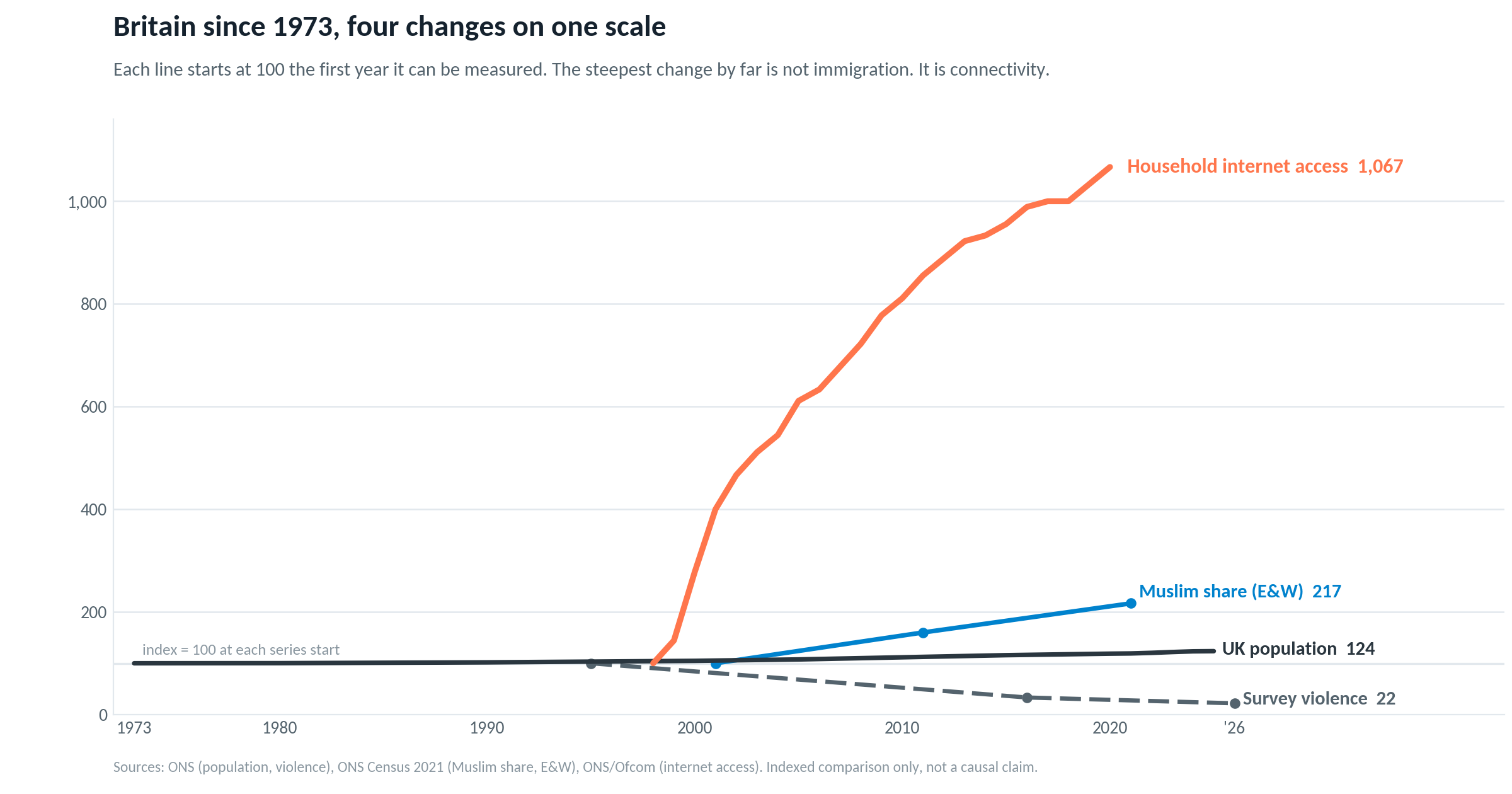
I ended up building an indexed chart. Not because index charts prove causation, they absolutely do not, but because they are good at showing how quickly different things have changed relative to each other. I set each series to 100 at its first usable reading. UK population starts at 100 in 1973 and reaches roughly 124 today. The Muslim share of England and Wales starts at 100 in 2001 and reaches about 217 by 2021. Household internet access starts at 100 in 1998 and passes 1,000 by 2020. And long-run survey violence, indexed to its 1995 peak, falls to around 22.
Sit with that for a second. The country got bigger. It became much more diverse. The Muslim population grew considerably. The internet absolutely exploded. And general violence fell dramatically. None of that proves immigration reduces crime, or that the internet causes social conflict, or anything causal at all. But it should make us instantly suspicious of any story where one line goes up and therefore another thing must have followed it. The biggest transformation on that chart is not immigration at all. It is connectivity.
Britain may have a perception crisis as much as a crime crisis
That does not mean perception is fake, though. Perception changes behaviour. My German friend in the beer queue was seriously considering not visiting Britain, and that has a real economic effect. If communities believe crime is out of control, it corrodes trust. If Muslims repeatedly see themselves depicted as invaders or predators, it affects how welcome they feel. If non-Muslim Britons only ever see the most extreme Islamist preacher, criminal or protester available anywhere in Europe, it shapes what they assume their actual Muslim neighbours think. And if politicians start responding to those perceptions instead of the reality underneath them, perception quietly becomes policy. Occasionally it becomes something worse than that, because the Home Office data on hate-crime spikes around major political and terrorist events makes painfully clear how fast feeling turns into action. Social media did not invent any of this hatred. It has just industrialised the distribution of it.
The most dangerous combination is real failure plus exaggeration
This, I think, is where Britain genuinely does have a problem. Not Sauron. Not imminent civil war. A feedback loop. Something genuinely bad happens. The authorities mishandle it at first. Politicians reach for careful language that comes across as evasive. People conclude there is a cover-up. Online accounts publish more and more extreme interpretations, the most emotionally powerful version travels furthest, and traditional media responds by correcting the exaggerations, sometimes without giving enough weight to the real failure sitting underneath them. That correction then gets read as further proof of the cover-up, trust falls again, and round it goes.
The grooming-gang scandal is almost the perfect illustration. Authorities really did fail. Ethnicity really was relevant in some places. People raising it really were sometimes dismissed. And that history has created extremely fertile ground for someone now to say almost anything about Muslims and be met with “well, they lied to us before.” That is an incredibly dangerous legacy, and it is precisely why accuracy matters even, especially, when accuracy is uncomfortable.
So has Britain been taken over?
No. That is ridiculous. Britain has been through enormous social change. Immigration became exceptionally high and has since fallen. The foreign-born population has grown, the Muslim population has grown, some communities have integrated brilliantly and some have not. A few crime problems have got worse while many forms of violence have got dramatically better. Some serious criminal patterns involving particular communities were ignored for far too long. Small boats are a genuine failure of border control but a minority of immigration. Muslims themselves experience a great deal of hate crime. And nearly everyone is now walking around with a machine in their pocket designed to feed them an unusually concentrated selection of whatever frightens, enrages or confirms them most efficiently.
That is a rather more complicated answer than “Britain has fallen.” Unfortunately, it also makes a terrible meme…
What I think we need to get better at saying
Most of this comes down to being able to hold two true things at the same time. Immigration can be too high without immigrants being bad people. Borders can matter without foreigners being the enemy. Integration can be expected without demanding cultural uniformity. Islamist extremism can exist without Islam being a synonym for it. Grooming gangs can show real ethnic patterns without Asian men in general being predators. Muslims can suffer genuine racism and religious hatred while some conservative Islamic beliefs can still be legitimately criticised. Violent crime can fall while sexual violence remains a serious worry. Recorded crime can rise while the underlying prevalence falls. And Britain can have serious problems without being a failed country.
If your politics cannot accommodate all of those sentences at once, I would gently suggest your politics has become more important to you than actually understanding what is happening.
Back to Düsseldorf
I do not know whether I changed the German guy’s mind. We had a drink, we talked about Britain, and I told him he should come over. He would probably survive! Most of us do. He might even enjoy it.
That conversation has stuck with me because it was the first time I properly realised the online story about Britain is not staying online. It is quietly becoming Britain’s international reputation. And I do not want that corrected with propaganda about how everything here is wonderful, because it is not. I want it corrected by us being adult enough to talk honestly about what has actually gone wrong, measure it properly, and refuse to flatten millions of different people into one convenient villain.
Britain has not been conquered by Sauron and the Nazgûl. We have got immigration problems, political problems, crime problems, cultural tensions, failing institutions, a fair bit of social-media brain rot and some genuinely appalling data quality. Which is to say… Britain. Messy. Occasionally infuriating. Still here. And almost certainly a good deal safer than your phone makes it look.
First thing I have written here in a while. I have been heads-down building Jawwws, but I have missed thinking out loud in long form, so I am planning to do more of it here again.
Where the numbers come from
- Population, 1973 and mid-2025: ONS UK population time series and provisional mid-2025 estimate. https://www.ons.gov.uk/peoplepopulationandcommunity/populationandmigration/populationestimates/timeseries/ukpop and https://www.ons.gov.uk/peoplepopulationandcommunity/populationandmigration/populationestimates/bulletins/provisionalpopulationestimatefortheuk/latest
- Net migration peak and latest, foreign-born stock: ONS long-term international migration, and House of Commons Library migration statistics. https://www.ons.gov.uk/peoplepopulationandcommunity/populationandmigration/internationalmigration/bulletins/longterminternationalmigrationprovisional/latest and https://commonslibrary.parliament.uk/research-briefings/sn06077/
- Reason for non-EU immigration (study 47%, work 23%, asylum 14%): ONS, Long-term international migration, provisional, year ending December 2025. https://www.ons.gov.uk/peoplepopulationandcommunity/populationandmigration/internationalmigration/bulletins/longterminternationalmigrationprovisional/yearendingdecember2025
- Muslim population, 2001 to 2021, and UK-born share: Census 2021 religion, and 2011 census analysis of ethnicity and religion by country of birth. https://www.ons.gov.uk/peoplepopulationandcommunity/culturalidentity/religion/bulletins/religionenglandandwales/census2021 and https://www.ons.gov.uk/peoplepopulationandcommunity/culturalidentity/ethnicity/articles/2011censusanalysisethnicityandreligionofthenonukbornpopulationinenglandandwales/2015-06-18
- Small boats and asylum: Home Office immigration system statistics, illegal entry routes and asylum. https://www.gov.uk/government/statistics/immigration-system-statistics-year-ending-december-2025/how-many-people-come-to-the-uk-via-illegal-entry-routes and https://www.gov.uk/government/statistics/immigration-system-statistics-year-ending-december-2025/how-many-people-claim-asylum-in-the-uk
- Grooming gangs and national data quality: 2025 National Audit on Group-based Child Sexual Exploitation and Abuse (the Casey audit). https://www.gov.uk/government/publications/national-audit-on-group-based-child-sexual-exploitation-and-abuse/national-audit-on-group-based-child-sexual-exploitation-and-abuse-accessible
- Violence, homicide and sexual assault: ONS Crime in England and Wales, ONS Homicide in England and Wales, ONS Sexual offences overview. https://www.ons.gov.uk/peoplepopulationandcommunity/crimeandjustice/bulletins/crimeinenglandandwales/yearendingmarch2026 , https://www.ons.gov.uk/peoplepopulationandcommunity/crimeandjustice/articles/homicideinenglandandwales/latest and https://www.ons.gov.uk/peoplepopulationandcommunity/crimeandjustice/bulletins/sexualoffencesinenglandandwalesoverview/yearendingmarch2025
- Hate crime, survey versus recorded, and event spikes: Home Office Hate crime, England and Wales, year ending March 2025. https://www.gov.uk/government/statistics/hate-crime-england-and-wales-year-ending-march-2025/hate-crime-england-and-wales-year-ending-march-2025
- Internet access, social media use and online hate exposure: ONS internet access, and Ofcom media use and experiences of hateful content. https://www.ons.gov.uk/peoplepopulationandcommunity/householdcharacteristics/homeinternetandsocialmediausage/bulletins/internetaccesshouseholdsandindividuals/2020 and https://www.ofcom.org.uk/online-safety/online-abuse/experiences-of-hateful-content
- Interview wording: transcript archive and contemporary reporting of the Economist interview.














You must be logged in to post a comment.